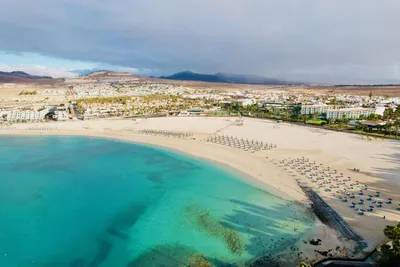
Aerial view of the horseshoe bay at Caleta de Fuste, with hotels and apartment blocks along the shore, a small rocky headland and the beach running along the water's edge

Photo: Sebaso (CC BY-SA 4.0), via Wikimedia Commons

Caleta de Fuste, Fuerteventura

Playa del Castillo

A sheltered horseshoe bay with calm, shallow water and an 18th-century watchtower

Playa del Castillo is the 700-metre curve of golden sand at the heart of Caleta de Fuste, on Fuerteventura's east coast. The bay wraps round in a horseshoe and takes the swell before it reaches the shore, so the water stays shallow and calm — one of the safest swimming beaches on the island for young children and nervous swimmers. The 18th-century watchtower that gave the resort its name still stands beside the sand, and the airport is barely ten minutes up the FV-2.

A bay shaped for calm water

Playa del Castillo runs for about 700 metres along the front of Caleta de Fuste and is roughly 40 metres deep at its widest. What makes it work is the shape: the bay curves round in a horseshoe, and its arms absorb the swell before it reaches the sand.

The result is water that stays shallow and calm well out from the shore, and it is consistently described as among the safest swimming on Fuerteventura. For toddlers taking their first steps into the sea, or for anyone who is not a confident swimmer, there are few better options on the island — and none this close to the airport.

It is a town beach rather than a wild one, and it makes no secret of that. Sunbeds, a promenade and restaurants sit directly behind the sand, and the water inside the bay rarely does anything dramatic. If you want Atlantic drama, the west coast is an hour away. If you want to read while the children paddle, this is the beach.

The castle that gave the beach its name

The low round tower at the edge of the bay is the Castillo de San Buenaventura, also called the Castillo de Caleta de Fuste, and it is why both the beach and the resort — 'El Castillo' in everyday speech — are named as they are.

It was built around 1743, ordered by the archipelago's commanding general of the day as a defence against the raids that plagued this coast: French and English ships, and Barbary corsairs. A garrison here could also raise the alarm and warn the rest of the island that raiders had landed. It was declared a historic-artistic monument in 1949.

It is a modest building — a squat circular watchtower, not a fortress — but it is genuinely 18th-century, and it stands close enough to the water that you can walk over to it barefoot from your sunbed.

Resort life around the bay

Sunbeds and parasols along the beach promenade at Playa del Castillo, Caleta de Fuste
The beach promenade at Playa del Castillo · Photo: Patrick F (CC BY-SA 3.0), Wikimedia Commons

Everything in Caleta de Fuste is arranged around this beach. A promenade runs behind the sand with sunbeds and parasols out along it, restaurants and bars face the water, and the marina sits at one end. Shops, hotels and apartment blocks are all within a few minutes' walk, golf courses lie just inland, and the Acua Water Park is inside the resort itself — enough to fill a week without ever getting in a car.

It is also a practical base rather than only a sunbathing one. Diving operators and watersports centres work out of the marina, boat trips leave from the same place, and the sheltered bay is an easy setting to try windsurfing for the first time before taking it to a windier corner of the island.

The resort sits on the FV-2 about 7km south of Fuerteventura airport — around ten minutes by car and one of the shortest transfers on the island, which counts for a lot with small children after an early flight. Puerto del Rosario, the island capital, is roughly fifteen minutes further north.

Where is Playa del Castillo?

Frequently asked questions