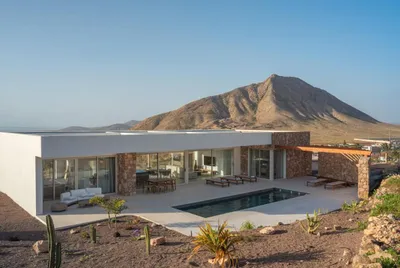
The isolated pale dome of Montaña de Tindaya rising above the flat plain in northern Fuerteventura

Photo: Jumilla (CC BY 2.0), via Wikimedia Commons

La Oliva, Fuerteventura

Montaña Tindaya

A sacred mountain you can photograph but are not free to climb.

Montaña de Tindaya rises 401 metres out of the flat Esquinzo plain in the north of Fuerteventura, a pale trachyte dome that the island's pre-Hispanic majos treated as a sacred place. Hundreds of footprint carvings, or podomorphs, are cut into the rock near the summit. Do not plan a hike on the strength of that: the mountain is a protected natural monument and cultural asset, the summit route requires written permission from the Cabildo and has been reported closed, and the carvings are not on public display.

What you can and cannot do here

This is the part people get wrong, so it comes first. Montaña de Tindaya is protected twice over — as a natural monument for its geology, and as a cultural asset covering the whole mountain under a 2023 decree — and you cannot simply park up and walk to the top. Access to the summit area requires written authorisation from the Cabildo de Fuerteventura's environment department, applied for in advance at their offices in Puerto del Rosario or Corralejo; allow a couple of weeks. Walking guides have reported the summit route closed indefinitely since 2025, so treat permission as something to confirm, not assume.

The carvings themselves are the reason for all of this. They sit high on the mountain, above roughly the 300-metre contour, on exposed rock that footfall damages, and they are not laid out as a visitor attraction with paths and panels. Nobody is going to show you round them on a casual visit. What is freely open is the flat country around the base, crossed by tracks and farm roads with clear views up the slopes, and this is where the mountain looks its best in any case. Some local operators run guided ascents that include the permit paperwork — if the summit genuinely matters to you, that is the route worth investigating, well before you travel.

Footprints in the rock, and a sculpture that never happened

The majos, Fuerteventura's pre-Hispanic inhabitants, carved footprint shapes into Tindaya's upper slopes. The island's heritage inventory records 111 engraved panels holding roughly 244 individual podomorphs, though a figure of over 300 circulates widely — either way, it is one of the largest concentrations of this kind of carving anywhere in the Canaries, and a rare one worldwide. Why they were made is genuinely unknown; the interpretations range from marking possession of territory to dispensing justice to a magical or religious rite. Many face towards Teide on Tenerife, visible from the summit on a clear day, which has fed a good deal of speculation without settling anything.

The mountain's recent history has been rougher. Its trachyte is a handsome ornamental stone and was quarried commercially until relatively recently, biting into the flanks. Then in the 1990s the Basque sculptor Eduardo Chillida proposed hollowing a vast cubic chamber inside the mountain as a Monument to Tolerance, open to the sky and the horizon. It became one of the longest-running environmental disputes in the Canaries, and decades on nothing has been excavated. The 2023 heritage designation makes it very unlikely anything ever will.

Where is Montaña Tindaya?

Frequently asked questions